How Blackjack Hand Values Work
Blackjack hand values make more sense when you can total the cards, recognise soft and hard hands, and distinguish a natural from any other 21.
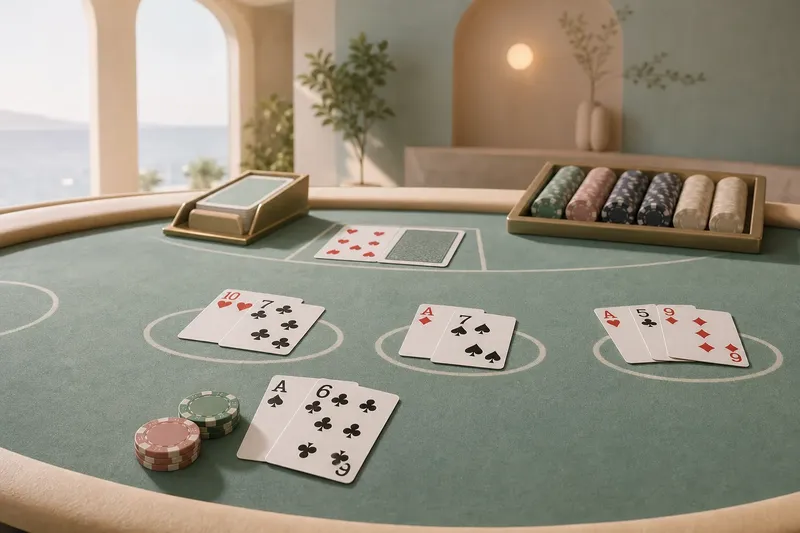
Blackjack hand values depend on the cards in front of you and, above all, on how an ace is counted. Add the cards using an ace as one or eleven, choosing the value that keeps the total at or below 21.
That flexibility explains why a soft 17 and a hard 17 are different kinds of hand, even though both total 17 at that moment. The labels describe how the total is formed, while “natural blackjack” has a separate, narrower meaning.
Card values establish the total
Number cards count at face value. A 2 is worth two, and a 7 is worth seven. Jacks, queens, kings and 10s each count as ten.
An ace counts as eleven when doing so keeps the total at 21 or below. If eleven would take the hand over 21, count that ace as one instead. With more than one ace, choose values that keep the hand within 21; an ace counted as eleven can be reduced to one if needed.
- 8 and 6 total 14.
- A queen and 5 total 15.
- Ace and 7 can total 8 or 18; the higher valid total is 18.
- Ace, 7 and 9 total 17, because counting the ace as eleven would produce 27.
For a quick calculation, add the non-ace cards, then give one ace the value of eleven if that leaves the highest total at or below 21. Count any other aces as one unless a different combination remains within the limit.
Soft and hard describe the ace, not just the total
A hand is soft when an ace is currently counted as eleven. Ace and 6 is soft 17. If another card would push the total over 21, the ace can count as one instead, so the hand can be recalculated without removing a card.
For example, add a 9 to ace and 6. Eleven plus six plus nine would make 26, so the ace shifts to one and the total becomes 16. The resulting hand is hard 16 because no ace remains at eleven.
A hand is hard if it has no ace or if every ace must count as one to keep the total at or below 21. A 10 and 7 is hard 17; so is ace, 6 and 10. The presence of an ace alone does not make a hand soft.
When using a strategy chart, identify the hand as soft or hard before looking up a play. The chart may also depend on the dealer’s upcard and the table’s rules.
A natural blackjack is a specific two-card hand
A natural blackjack is an opening hand of exactly two cards: an ace and any ten-valued card. The second card may be a 10, jack, queen or king.
A 21 made with three or more cards is still a total of 21, but it is not a natural. For instance, a player dealt 7 and 4 who then receives a 10 has a three-card 21. The distinction can affect settlement under the table’s rules.
Two aces are not a natural blackjack. They make 12 when one ace counts as eleven and the other as one; a natural requires an ace and a ten-valued card.
Which blackjack hand label fits the cards?
What does soft 18 mean?
Soft 18 is a total of 18 with an ace counted as eleven. Ace and 7 is one example; a hand with more cards also qualifies if an ace remains at eleven.
Can a hand with an ace be hard?
Yes. If the ace must count as one and none can remain at eleven, the hand is hard. Ace, 6 and 10 is hard 17.
Is every total of 21 a natural blackjack?
No. A natural is the opening two-card combination of an ace and a ten-valued card. A 21 reached with additional cards is not a natural.
What if the hand still exceeds 21 after the ace counts as one?
Then the hand is bust. The ace can change from eleven to one, but it cannot take a value below one.
How should you classify a blackjack hand before playing?
Say you are dealt an ace and 5 while the dealer shows a 6. The cards total soft 16: the ace counts as eleven, and could shift to one if a later card required it. You would look for soft 16 on a strategy chart rather than treating the hand as hard 6; the classification identifies the right chart entry but does not, by itself, determine the play.
Use this order when reading a hand:
- Check the non-ace cards: if their total is clear, add it first; if not, calculate each card at its stated value.
- Check each ace: if one can count as eleven without taking the hand over 21, count it that way; otherwise count it as one.
- Classify the total: if an ace remains at eleven, call the hand soft; if not, call it hard.
- Check the opening cards: if they are exactly an ace and a ten-valued card, call it a natural; otherwise describe it by its total and type.
- Compare the dealer’s upcard and posted rules with the strategy chart: if its assumptions match, use the corresponding entry; if they do not, find a chart for those rules or ask the dealer which rules apply.
Imagine you receive ace, 5 and 9, and the dealer shows a 6. First add 5 and 9 to make 14. Counting the ace as eleven would make 25, so count it as one and record hard 15; the hand is not a natural because it has three cards. You would then consult the hard-15 entry for the dealer’s 6, using a chart that matches the table rules. The result is a clear classification, not a play recommendation based on the total alone.
For blackjack hand values, keep the ace’s current role separate from the number on the table: that tells you whether a total is soft or hard. Then reserve “natural” for the opening ace-and-ten combination, and check the table rules before applying a strategy chart.